Qu'est-ce que Sens de déroulement des rouleaux d'étiquettes?
Lors de la commande d'étiquettes en rouleau personnalisées, de nombreux clients se concentrent sur le visuel, le matériau, la taille et la finition, mais négligent un détail très important : le sens de déroulement.
Choisir le mauvais sens de déroulement peut entraîner de graves problèmes lors de l'étiquetage automatique, notamment un mauvais alignement des étiquettes, des temps d'arrêt machine et une baisse de l'efficacité de la production.
Dans cet article, nous expliquons ce que signifie le sens de déroulement, pourquoi il est important et comment choisir le bon sens de déroulement pour vos rouleaux d'étiquettes.
Que signifie « sens de déroulement » ?
Le sens de déroulement fait référence à l'orientation des étiquettes lorsqu'elles se déroulent du rouleau lors de l'application.
En d'autres termes, cela décrit :
- Quel bord apparaît en premier ?
- Positionnement de l'étiquette sur le rouleau
- Orientation de l'étiquette lors de l'étiquetage automatique
Les différentes étiqueteuses nécessitent des sens de déroulement différents.
Pourquoi le sens de déroulement est-il important ?
Le sens de déroulement correct garantit :
- Fonctionnement fluide des étiqueteuses automatiques
- Placement précis des étiquettes
- Vitesse de production stable
- Temps de réglage de la machine réduit
- Risque réduit d'erreurs d'étiquetage
Si le sens de déroulement est incorrect :
- Les étiquettes peuvent être apposées latéralement
- Le texte peut apparaître à l'envers
- Les capteurs peuvent ne pas détecter correctement les espaces.
- Les opérateurs peuvent avoir besoin de rembobiner les bobines manuellement.
Cela peut entraîner une perte de temps et une augmentation des coûts de production.
Instructions de relaxation courantes
Dans l'industrie de l'étiquetage, le sens de déroulement est généralement décrit à l'aide de positions d'horloge.
Les types les plus courants sont :
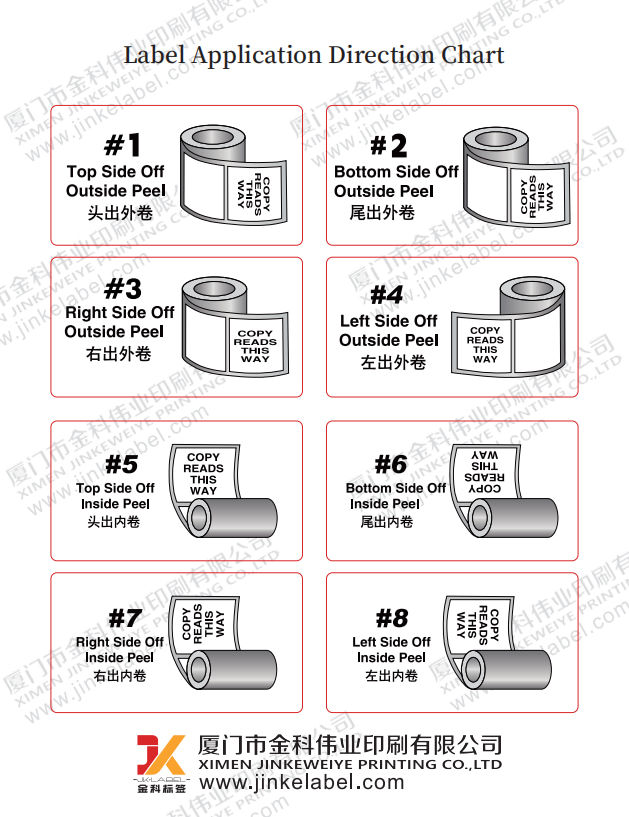
Ces chiffres indiquent l'orientation de l'étiquette vue de l'extérieur du rouleau.
Les systèmes de numérotation peuvent varier légèrement selon les fournisseurs ou les régions ; une confirmation visuelle est donc toujours recommandée.
Bord supérieur en premier vs bord inférieur en premier
Une autre façon courante de décrire le sens de déroulement est :
- Bord supérieur en premier
- bord inférieur en premier
- Bord gauche en premier
- Bord droit en premier
Cette méthode est souvent plus facile pour les clients qui ne connaissent pas la terminologie de l'industrie de l'étiquetage.
Par exemple:
- L'étiquette avant d'une bouteille peut exiger la mention « le haut en premier ».
- Une étiquette apposée sur le côté peut nécessiter l'indication « gauche en premier ».
Le choix approprié dépend de la configuration de l'étiqueteuse.
Comment déterminer le sens de déroulement correct
1. Vérifiez votre étiqueteuse
La méthode la plus simple consiste à demander à votre fournisseur ou opérateur de machine.
Ils savent généralement :
- sens d'alimentation du rouleau
- position du capteur
- Orientation de l'application
Fournir des photos ou des vidéos de la machine peut aider à éviter les erreurs.
2. Confirmer le sens d'application de l'étiquette
Réfléchissez à la manière dont l'étiquette sera apposée sur le produit :
- Application verticale
- Application horizontale
- Application enveloppante
Différentes applications peuvent nécessiter différentes directions de déroulement.
3. Fournir un échantillon de rouleau
Si vous avez déjà utilisé avec succès des étiquettes compatibles, l'envoi d'un rouleau d'échantillon à votre fournisseur est l'option la plus sûre.
Cela permet au fabricant d'associer :
- Direction du roulement
- Taille du noyau
- diamètre extérieur
- espacement
Autres spécifications des rouleaux à confirmer
Outre le sens de déroulement, plusieurs détails de roulage sont également importants.
Taille du noyau
Les tailles de noyau courantes comprennent :
- 25 mm
- 40 mm
- 76 mm (3 pouces)
Le diamètre de mandrin approprié dépend de votre étiqueteuse.
diamètre extérieur
Si le diamètre du rouleau est trop grand :
- Il se peut qu'il ne soit pas compatible avec le support de la machine.
Si trop petit :
- L'efficacité de la production diminue car les rouleaux doivent être remplacés fréquemment.
Écart entre les étiquettes
Les étiqueteuses automatiques utilisent des capteurs pour détecter les espaces entre les étiquettes.
Un écartement incorrect peut avoir des conséquences :
- Détection par capteur
- Positionnement de l'étiquette
- Précision de l'application
Problèmes courants causés par un sens de déroulement incorrect
1. Étiquettes à l'envers
Le problème le plus courant.
L'étiquette peut s'insérer correctement mais être appliquée à l'envers sur le produit.
2. Application d'étiquettes latérales
La machine peut appliquer l'étiquette pivotée de 90 degrés.
Cela arrive souvent lorsque l'orientation gauche/droite est mal comprise.
3. Erreurs des capteurs de la machine
Une orientation d'alimentation incorrecte peut perturber la détection par capteur.
Cela peut entraîner :
- Étiquettes ignorées
- Double alimentation
- Désalignement
Application manuelle vs application automatique
Pour une application manuelle, le sens de déroulement est généralement moins critique.
Cependant, pour :
- Étiquetage automatique à grande vitesse
- Étiquetage enveloppant
- lignes de production pharmaceutique
- lignes d'embouteillage de boissons
Le sens de déroulement correct est extrêmement important.
Comment JINKE LABEL soutient les projets d'étiquettes en rouleau
Chez JINKE LABEL, nous aidons nos clients à confirmer :
- Sens de déroulement correct
- Taille du noyau
- Diamètre du rouleau
- espacement
- Compatibilité machine
Nous prenons en charge les étiquettes pour :
- lignes d'embouteillage de boissons
- Emballage cosmétique
- produits pharmaceutiques
- Emballages alimentaires
- applications industrielles
Avant la production, notre équipe peut confirmer les spécifications des rouleaux en fonction de :
- Photos de machines
- Vidéos
- Rouleaux d'échantillons existants
- Dessins techniques
Cela permet de réduire les problèmes d'étiquetage lors de la production.
Réflexions finales
Le sens de déroulement peut sembler un détail, mais il est crucial pour l'application automatique des étiquettes. Choisir la bonne orientation du rouleau améliore l'efficacité de la production, réduit les temps d'arrêt machine et garantit un positionnement précis des étiquettes.
Avant de commander des étiquettes en rouleau personnalisées, veuillez toujours vérifier :
- Direction du déroulement
- Taille du noyau
- Diamètre du rouleau
- Écart d'étiquetage
- Exigences relatives à la machine
Si vous n'êtes pas certain du sens de déroulement requis par votre machine, n'hésitez pas à contacter JINKE LABEL pour obtenir une assistance technique et des recommandations en matière d'étiquettes.


 Français




 Sales Executive